


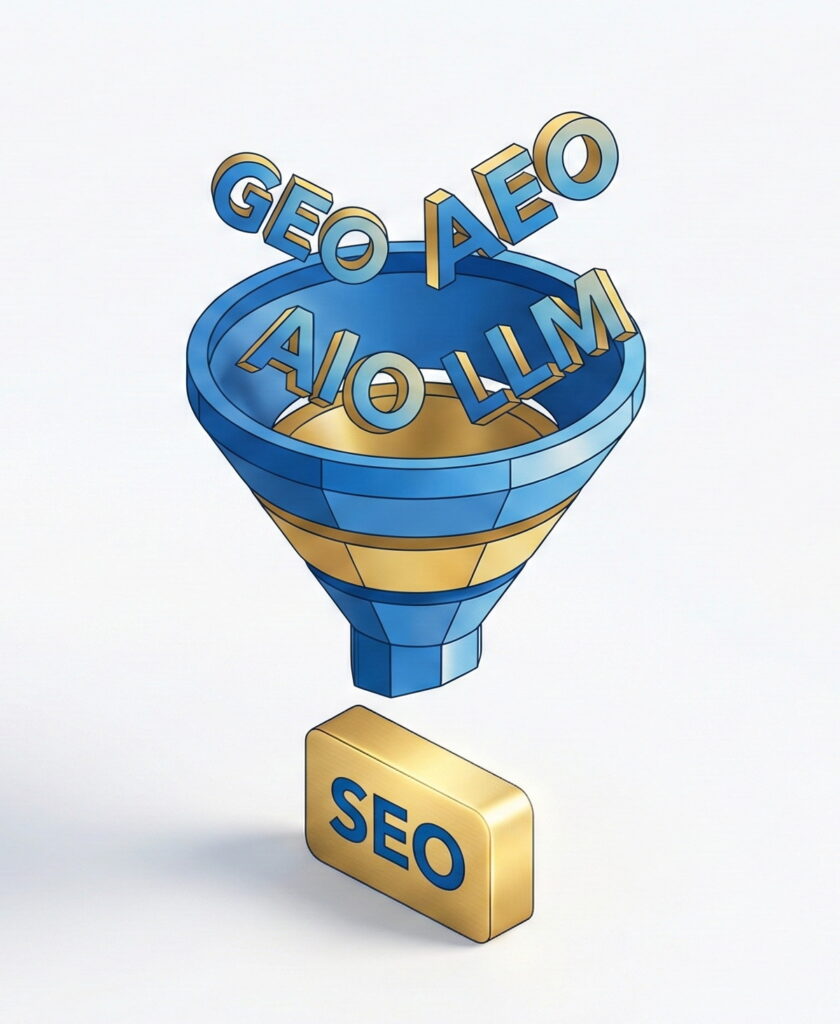
If you’ve been following the digital marketing news cycle lately, you might think the sky is falling. With the rise of AI Overviews, Chatbots, and an endless stream of new acronyms like GEO (Generative Engine Optimization) and AEO (Answer Engine Optimization), business owners are asking: Is SEO dead?
The short answer is no. But it is changing.
In a recent candid discussion on Google’s Search Off the Record podcast, Google’s Search Liaison Danny Sullivan and Search Advocate John Mueller broke down exactly what is happening with Search.
Here is our analysis of their conversation and its implications for your SEO business strategy moving forward.
1. Stop Worrying About the Acronyms
The industry loves to invent new names for things. We are hearing about GEO (Generative Engine Optimization), AEO (Answer Engine Optimization), and AIO (AI Optimization). Danny Sullivan jokingly referred to this trend as “LMNOP-EO”.
The reality? It is all still SEO.
Whether a user finds you through a traditional blue link, an AI-generated summary, or a voice assistant, the core goal remains the same: Optimizing your content so that search engines can understand it and present it to the right people.
You still should focus on the fundamental practice of improving content for search engines to help your audience find you.
2. The Future is “Multimodal” (Text is Not Enough)
For two decades, SEO was primarily about words on a page. Today, search is becoming “multimodal.” This means users aren’t just typing keywords; they are searching with images, video, and voice.
In the podcast, Google’s team gave a prime example: A user recording a video of geese eating grass and asking, “What are they doing?” The search engine analyzes the video, identifies the action, and provides a textual answer.
The Takeaway: If your content strategy relies solely is text, you are falling behind. We need to ensure your brand is visible through video, images, and audio, because that is how modern users and modern algorithms consume information.
3. Authenticity is Your Greatest Asset
This is the most critical point for 2026 and beyond. With AI tools, anyone can generate “commodity content” – generic facts that are already available to everyone else.
Google calls this the “Super Bowl Time” problem. If everyone writes a blog post stating the time the Super Bowl starts, that is just a commodity fact. It’s useful, but it doesn’t make you special.
To win in the age of AI, you need Authenticity and Original Voice.
- Don’t just state facts. Share your unique perspective.
- Show, don’t just tell. Use first-hand experience.
- Be human. AI can write a sentence, but it can’t share a personal story or a controversial professional opinion.
As Sullivan noted, your strength is your “original voice” that only you can provide.
4. Moving Beyond the Click
For years, the only metric that mattered was the “click.” But as Google evolves into an engine that provides answers directly (AEO), the user journey is changing.
We advise our clients to consider the bigger picture: Conversions and Engagement. Even if a user gets their answer from an AI summary without clicking, did that interaction build brand trust? Did they search for your brand name later?
The Apex Verdict
We have over 15 years of experience in this industry. We have seen trends come and go. The shift toward AI and “Answer Engines” is significant, but it doesn’t replace the need for high-quality, human-centric marketing.
In fact, it makes it more valuable. When the internet is flooded with AI-generated noise, expert, authentic content becomes the premium product.
Ready to future-proof your SEO strategy? Contact Apex Search Solutions today.